
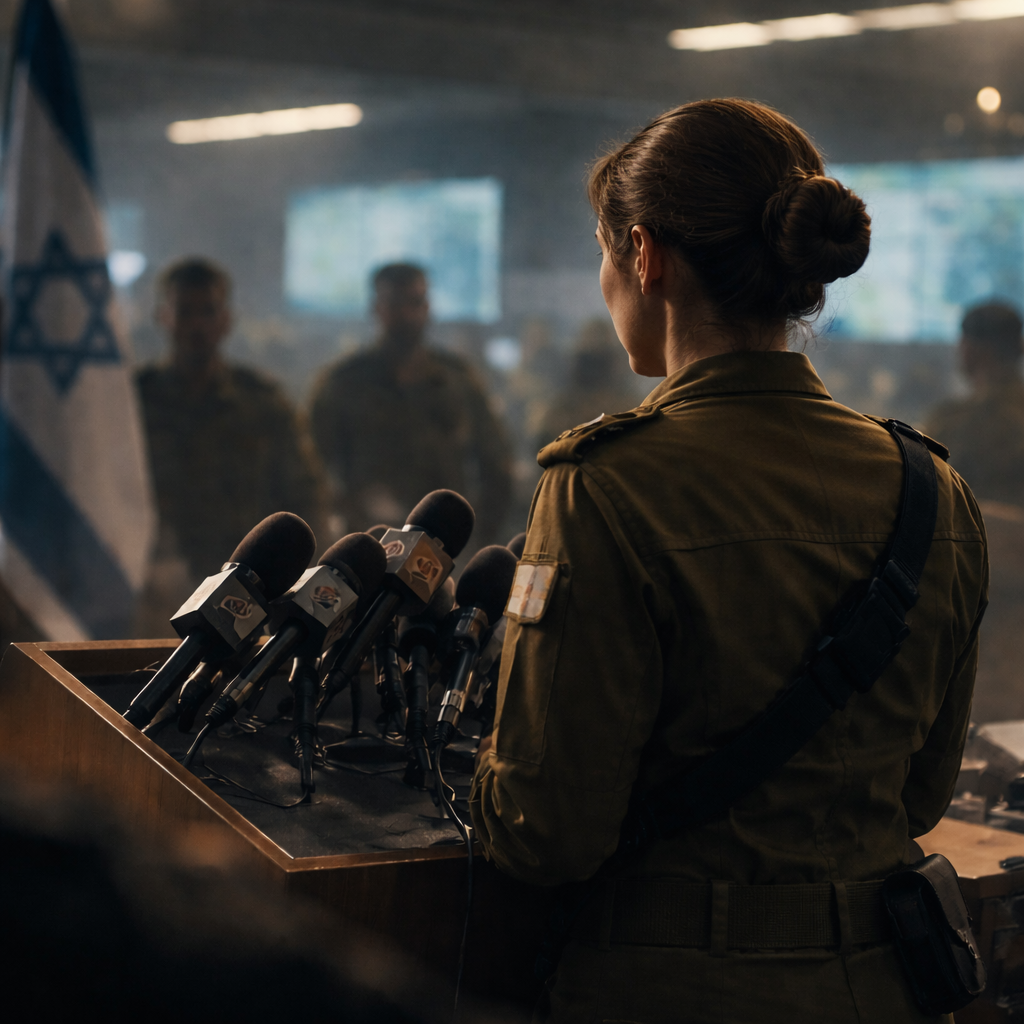
ISRAEL — Israel’s military has selected Major Ella Waweya, a Muslim Arab officer known publicly as “Captain Ella,” to become its next Arabic-language spokesperson, replacing Lieutenant Colonel Avichay Adraee after roughly two decades in the role. (Source – The Times of Israel, February 3, 2026; The Jerusalem Post, February 3, 2026; Tribune India, February 3, 2026)
Waweya currently serves as Adraee’s deputy within the Israel Defense Forces (IDF) spokesperson apparatus and is expected to take over the Arabic-language portfolio in the coming weeks, with Israeli outlets reporting she will be promoted to lieutenant colonel upon assuming the post. (Source – Tribune India, February 3, 2026; The Jewish Chronicle, February 4, 2026; Ynetnews, February 3, 2026)
The Arabic-language spokesperson is one of the IDF’s most visible communications roles for Arabic-speaking audiences, with messaging that is widely consumed across Palestine and the wider region during periods of escalation, including wartime claims, operational statements, and public-facing guidance. (Source – AFP via Spacewar, February 3, 2026; The Arab Weekly, February 4, 2026; The Times of Israel, February 3, 2026)
Waweya’s appointment has drawn attention across the Middle East because the position sits at the intersection of military public relations and conflict information flows—areas that directly affect Palestinian civilians and Arab and Muslim public opinion, especially amid the continuing Gaza war and regional tensions. (Source – The New Arab, February 3, 2026; Haaretz, February 3, 2026)
Representation and controversy in a wartime messaging role
Israeli media reports describe Waweya, 36, as one of the most senior Muslim Arab women in the IDF, and note she was born in the central Arab town of Qalansawe and joined the military voluntarily in 2013. (Source – The Times of Israel, February 3, 2026; Ynetnews, February 3, 2026)
For some Palestinian and wider Muslim audiences, the significance of the change is inseparable from how the Arabic spokesperson role has functioned during the Gaza war—when the IDF’s Arabic channels have been used to justify military actions and, at times, issue warnings or instructions that Palestinians say do not reliably translate into safety on the ground. (Source – The New Arab, February 3, 2026; The Arab Weekly, February 4, 2026)
Adraee’s public profile also shaped the sensitivity around the position: AFP reported he became strongly associated in Gaza and Lebanon with Israeli military campaigns and messaging, including the use of colloquial Arabic and religious references aimed at Arabic-speaking audiences—an approach that has been widely criticised as provocative or manipulative by many Muslims. (Source – AFP via Spacewar, February 3, 2026)
The appointment also lands in a domestic Israeli context where Arab citizens make up roughly one-fifth of the population but are widely underrepresented in state institutions, while most Arab citizens are exempt from compulsory military service and only a minority volunteer. (Source – Israel Central Bureau of Statistics, May 9, 2024; Council on Foreign Relations, June 14, 2021)
Islamic and Ethical Context
In Islamic ethics, public speech is not value-neutral: The Quran repeatedly links truthful testimony to justice and warns against deception that harms communities. In a conflict environment saturated with competing narratives, the moral burden on public communicators—especially those speaking in the name of armed power—only grows.
The Prophet (Peace be upon Him), in Hadith Books, emphasised the grave consequences of dishonesty and the responsibility to avoid causing harm through words. For Muslims watching this appointment, the central question is not only representation, but accountability: whether communications are used to protect life, uphold human dignity, and clarify facts, or to legitimise harm and obscure responsibility. The early record of statecraft and conflict in The Seerah underscores that power must be restrained by justice, and that communities must be treated with dignity even amid hostility.



Leave a Reply