
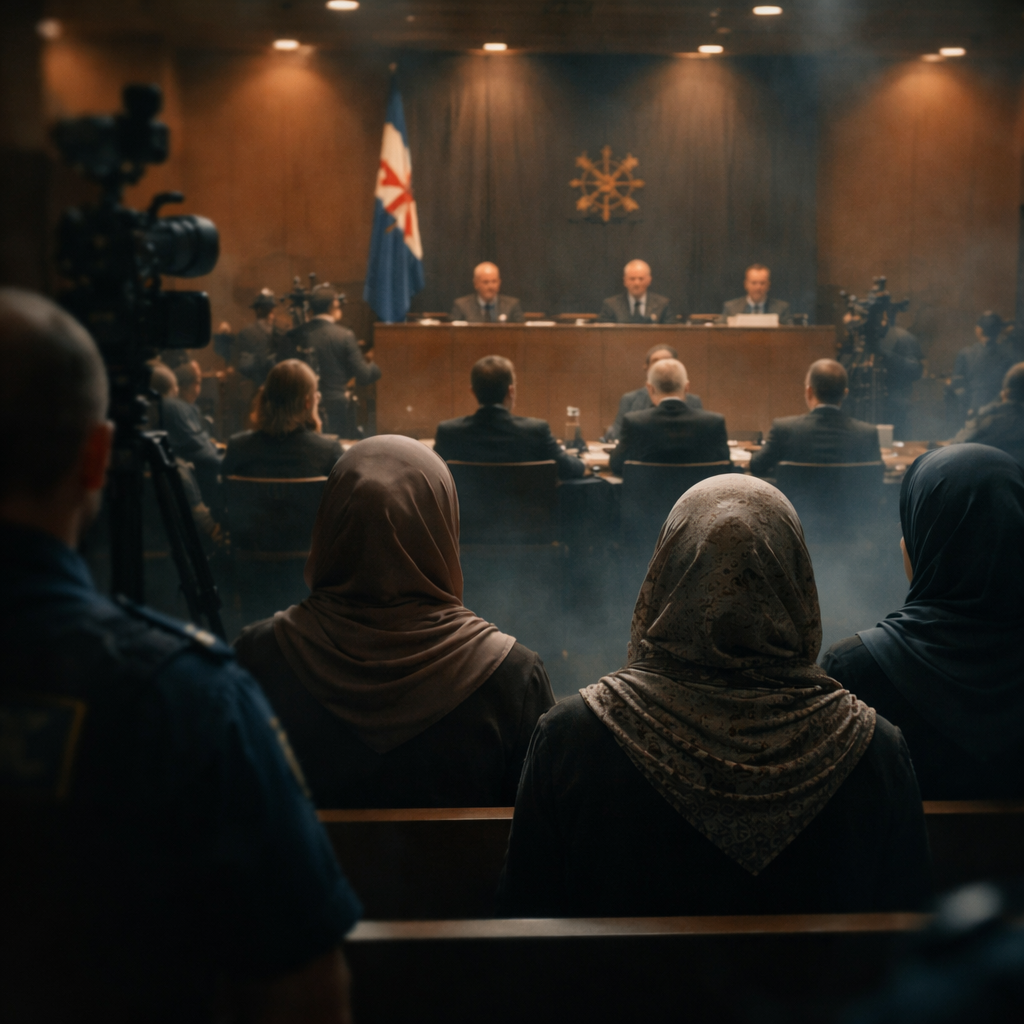
NEW ZEALAND — New Zealand’s Court of Appeal is due to begin a five-day hearing on Monday, February 9, 2026, to consider a convicted terrorist’s application to vacate his guilty pleas for the 2019 Christchurch mosque shootings and to seek leave to appeal out of time. (Source – Courts of New Zealand, 5 February 2026)
The case concerns Brenton Tarrant, who pleaded guilty on March 26, 2020 to 51 charges of murder, 40 charges of attempted murder, and one charge of committing a terrorist act, arising from a mass shooting on March 15, 2019 at Al Noor Mosque and Linwood Islamic Centre. (Source – Courts of New Zealand, 5 February 2026; Radio New Zealand, 3 December 2025)
He was sentenced in August 2020 to life imprisonment without parole, with the High Court describing the offending as an ideologically motivated attack on worshippers at a place of prayer. (Source – Courts of New Zealand, 27 August 2020)
According to a court-published case synopsis, the central issue for the Court of Appeal will be whether, at the time of the guilty pleas, he was “incapable of making rational decisions” due to the conditions of his imprisonment, which he alleges were torturous and inhumane. (Source – Courts of New Zealand, 5 February 2026)
What the hearing could mean for victims and the wider public
The Court of Appeal synopsis says the February hearing is primarily about whether the guilty pleas should be vacated and whether leave should be granted to appeal convictions out of time; if the court declines to vacate the pleas, a further hearing later in 2026 is expected to consider any sentence appeal. (Source – Courts of New Zealand, 5 February 2026)
If the court grants the application to vacate the guilty pleas, the synopsis says the sentence appeal would fall away and the case would be sent back to High Court of New Zealand for trial on the charges. (Source – Courts of New Zealand, 5 February 2026)
The court has also set out access arrangements indicating limited courtroom attendance, streaming to an adjoining courtroom with a one-hour delayed broadcast, and provision for victims and family members to view from Christchurch via delayed broadcast, with additional security measures including registration and surrender of cell phones. (Source – Courts of New Zealand, 5 February 2026; Courts of New Zealand, 22 January 2026)
For many Muslim families and survivors, the proceedings risk reopening trauma while the justice system tests whether any legal threshold for undoing pleas has been met. New Zealand reporting in recent years has documented concerns from survivors and bereaved relatives about the attacker using formal processes as a platform, including objections raised in separate coronial proceedings. (Source – Radio New Zealand, 24 October 2025; ABC News, 7 November 2021)
New Zealand’s Royal Commission of Inquiry into the Christchurch mosque attacks, and subsequent government responses, have highlighted long-running concerns raised by Muslim communities about Islamophobia, social cohesion, and the need for public agencies to better recognise and respond to threats targeting minorities. (Source – Department of the Prime Minister and Cabinet, 12 August 2024; Royal Commission of Inquiry, Executive Summary, 2020)
Islamic and Ethical Context
In Islam, the sanctity of life is central, and the pursuit of justice is not optional; it is a public duty that must be carried out fairly and without vengeance. The Quran repeatedly frames justice as a moral obligation, including the requirement to uphold truth even when it is difficult, and to protect the vulnerable.
At the same time, justice must be administered with integrity and restraint. Hadith Books emphasise due process, the seriousness of testimony, and the responsibility of authorities to prevent harm—principles that resonate strongly when Muslim survivors say legal proceedings can retraumatise families if not handled with care.
The Seerah records that the Prophet Muhammad (Peace be upon Him) upheld justice consistently while seeking to prevent cycles of harm in society. For Muslim communities in New Zealand and beyond, that balance—fair legal process alongside protection of victims and community safety—remains the ethical test as the case returns to court.



Leave a Reply