
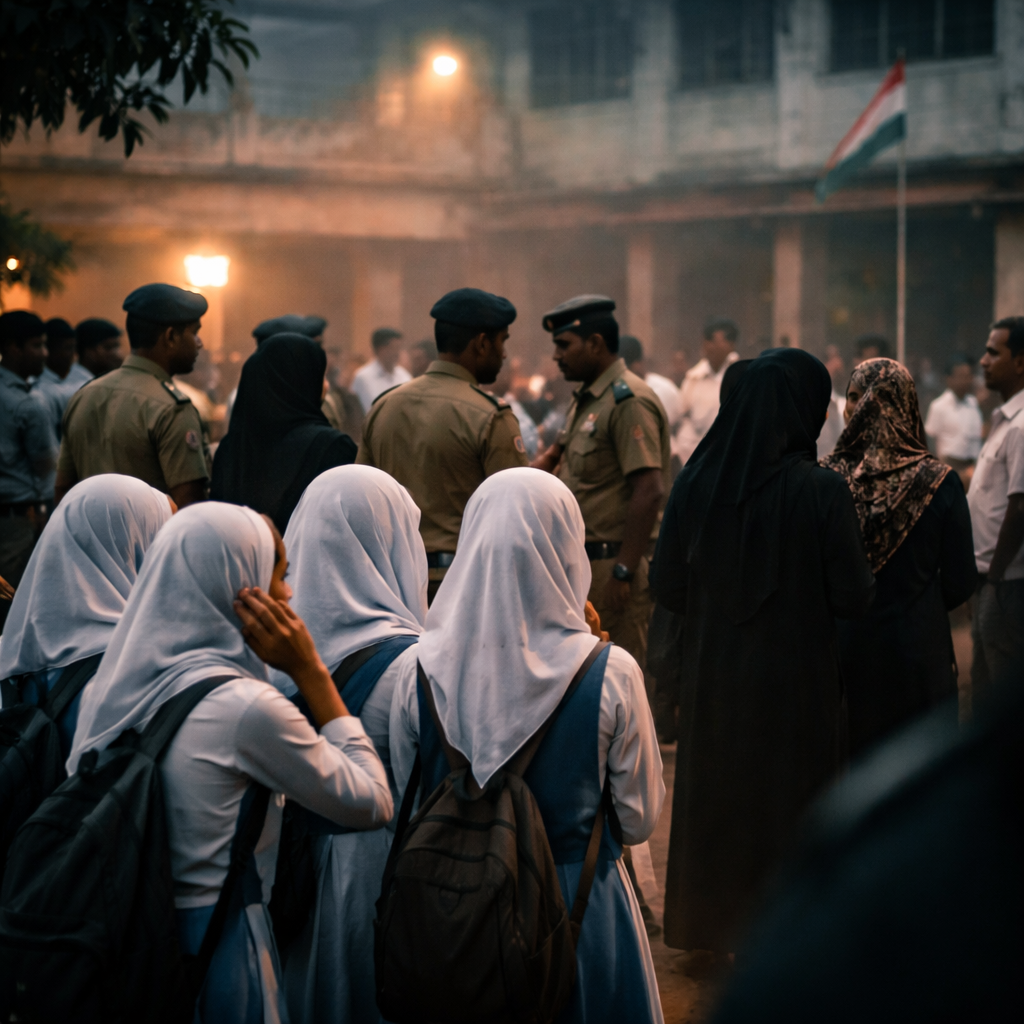
INDIA — Authorities in eastern India’s Jharkhand state have opened an inquiry after Muslim schoolgirls alleged they were blocked from entering class and assaulted for refusing to remove their hijab at a government-run girls’ school in Chatra district, highlighting renewed tensions over religious attire and school dress codes. (Source – The New Indian Express, July 16, 2025; The Times of India, July 17, 2025)
The allegations were made by students at a state-sponsored “Plus Two” girls’ school in the Marwari Mohalla area of Chatra, according to a written complaint cited in local reporting. The students and parents said the principal had issued verbal instructions against wearing a hijab or even a dupatta within the school premises, and claimed staff forcibly removed coverings and threatened expulsion if the students protested. (Source – The New Indian Express, July 16, 2025)
The principal denied the accusations, saying the school’s dress code applies to all students and describing the incident as being misrepresented. District education officials also indicated they had not previously received similar complaints during inspections, while local administrators said they would speak to students, teachers and parents to resolve the dispute and determine whether any wrongdoing occurred. (Source – The New Indian Express, July 16, 2025; The Times of India, July 17, 2025)
After the confrontation, the girls went with their parents to the district hospital for a medical examination, and a doctor said no marks of beating were found, according to reports. Local officials, including the sub-divisional officer, visited the hospital and said the case would be investigated “impartially,” with action to follow if anyone is found at fault. (Source – The New Indian Express, July 16, 2025)
Authorities order inquiry as schools face pressure over dress codes
Jharkhand’s government ordered an inquiry into the allegations, as the incident prompted public scrutiny and raised questions about how schools should handle religious attire while maintaining discipline and uniform rules. The complaint and the principal’s denial have left key details contested, and officials have not publicly released a full timeline or findings from the inquiry at this stage. (Source – The Times of India, July 17, 2025; The New Indian Express, July 16, 2025)
The episode comes amid a broader national debate in India over whether uniform policies can restrict visible religious clothing in educational settings. The country’s highest court has dealt with related disputes in recent years, including challenges linked to Karnataka’s 2022 headscarf controversy in pre-university colleges, where the Supreme Court delivered a split verdict that left the matter to be reheard by a larger bench. (Source – Supreme Court Observer, October 16, 2022; Al Jazeera, October 13, 2022)
Policies and outcomes also vary sharply across states and institutions. Karnataka’s government later said it would withdraw the prior hijab ban order introduced under the previous administration, underscoring how shifts in state policy can change day-to-day access to classrooms for Muslim students. (Source – The Times of India, December 22, 2023)
Islamic and Ethical Context
For many Muslim families, a schoolgirl’s hijab is tied to identity, dignity, and a sense of modesty rooted in The Quran, and disputes over removing it can feel less like a uniform question and more like pressure to set aside a deeply held practice in public life.
At the same time, Islam’s ethical tradition—reflected across Hadith Books—emphasizes protection from harm, fair treatment, and the safeguarding of children’s wellbeing, principles that align with expectations that schools and authorities respond to complaints with seriousness, due process, and care for students’ physical and emotional safety.
The life of the Prophet Muhammad (Peace be upon Him), as preserved in The Seerah, is often cited by Muslims as a model for resolving disputes with restraint and justice—an approach that, in contemporary settings, can translate into transparent investigations, accountability where warranted, and practical accommodations that allow students to learn without humiliation or coercion.
Leave a Reply