
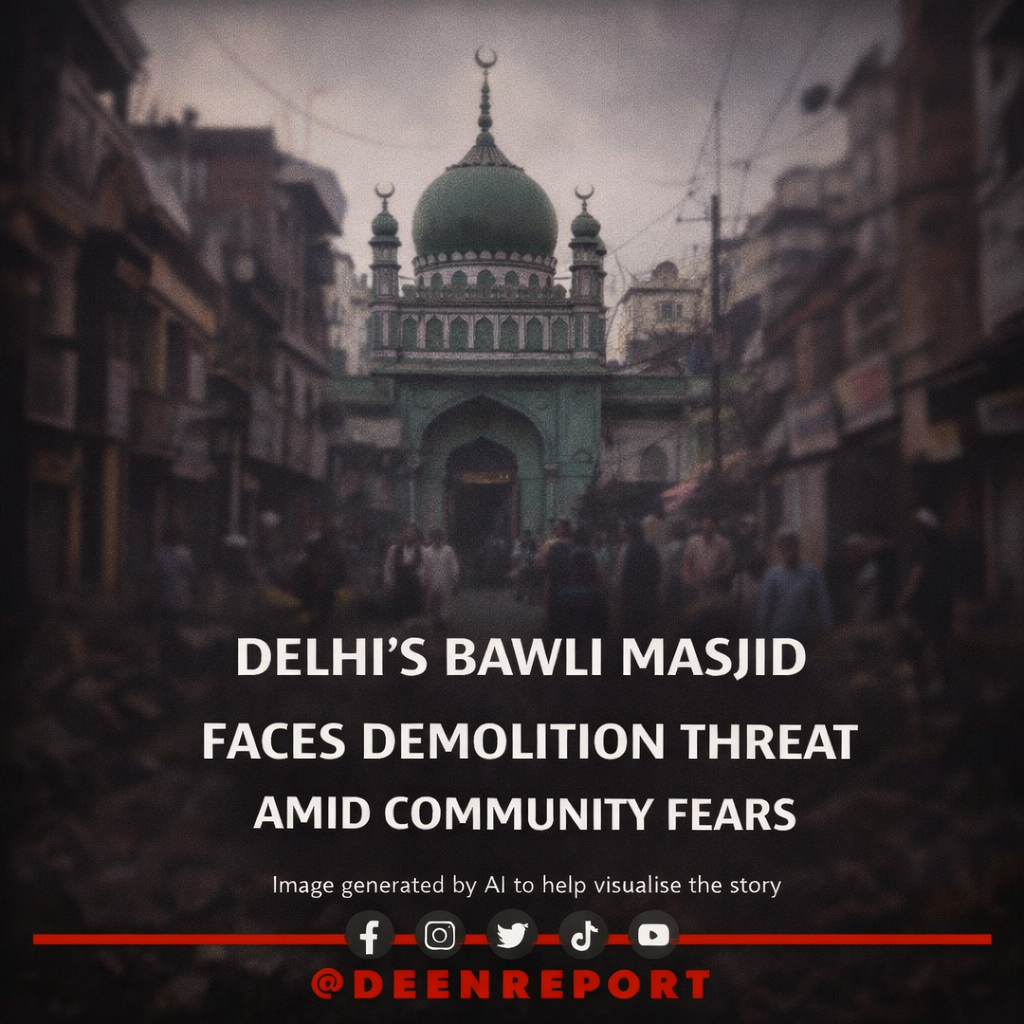
NEW DELHI — A mosque in south Delhi’s Defence Colony, known as Bawli Masjid, has become the focus of anxiety within India’s Muslim community after authorities were directed by the Delhi High Court to review allegations of encroachment — a move community leaders fear could lead to demolition, despite no order authorising such action.
The court’s directive, issued in early January 2026, asked the Municipal Corporation of Delhi (MCD) to inspect land records and verify claims that parts of the mosque’s property encroached on adjacent railway land. The legal order did not authorise immediate demolition, emphasising that action must follow lawful notice, hearing and due process.
Despite this, the case has rapidly become a centrepiece of public debate and media coverage, with some political commentators and local activists framing it as a test case of how religious properties are treated under India’s law. Muslim organisations say the speed and tone of the public response have raised fears that legal scrutiny could morph into a campaign targeting a place of worship.
Local community members tell Muslim Network TV that Bawli Masjid has stood for decades without prior objection from civic authorities and that maintenance and repairs over the years were conducted transparently. An imam associated with the mosque told reporters that while the congregation welcomes lawful inspection, the broader public agitation — amplified on television channels and social media — has fuelled anxiety rather than clarity.
The developments come against a backdrop of heightened scrutiny of other Muslim sites in Delhi, including the Faiz-e-Ilahi mosque at Turkman Gate, where a demolition drive linked to encroachment claims sparked clashes between residents and police, and drew attention from national political figures and rights activists.
Legal experts note that Indian law contains clear protections for places of worship and requires that any dispute over land or encroachment must be resolved through documented legal processes. Notices, hearings and judicial review are essential steps before any coercive action such as demolition can be taken. Civil liberties advocates emphasise that rule of law should prevail over public pressure or televised outrage.
Historians and preservationists also point to the rich architectural and cultural heritage of Delhi’s mosques, some of which date back centuries, and argue that allegations of encroachment should be rigorously examined by heritage and legal experts rather than becoming fodder for political conflict. Previous cases involving historic mosques, such as the centuries-old Masjid Akhonji in Mehrauli, which was controversially demolished in 2024 despite its heritage value, illustrate the sensitivities around such issues.
At the same time, Muslim community organisations have called for calm and constructive engagement with authorities, urging that any disputes be resolved through transparent legal mechanisms and respectful dialogue. They continue to emphasise equality before the law and caution against selective enforcement that may disproportionately affect minority places of worship.
The MCD is expected to complete its inspection and file a report with the High Court in the coming weeks, after which the next legal steps — if any — will be determined. Until then, Bawli Masjid remains standing, but the episode has already stirred wider concerns about religious freedom, civic rights, and the protection of minority heritage in India’s capital.


Leave a Reply