
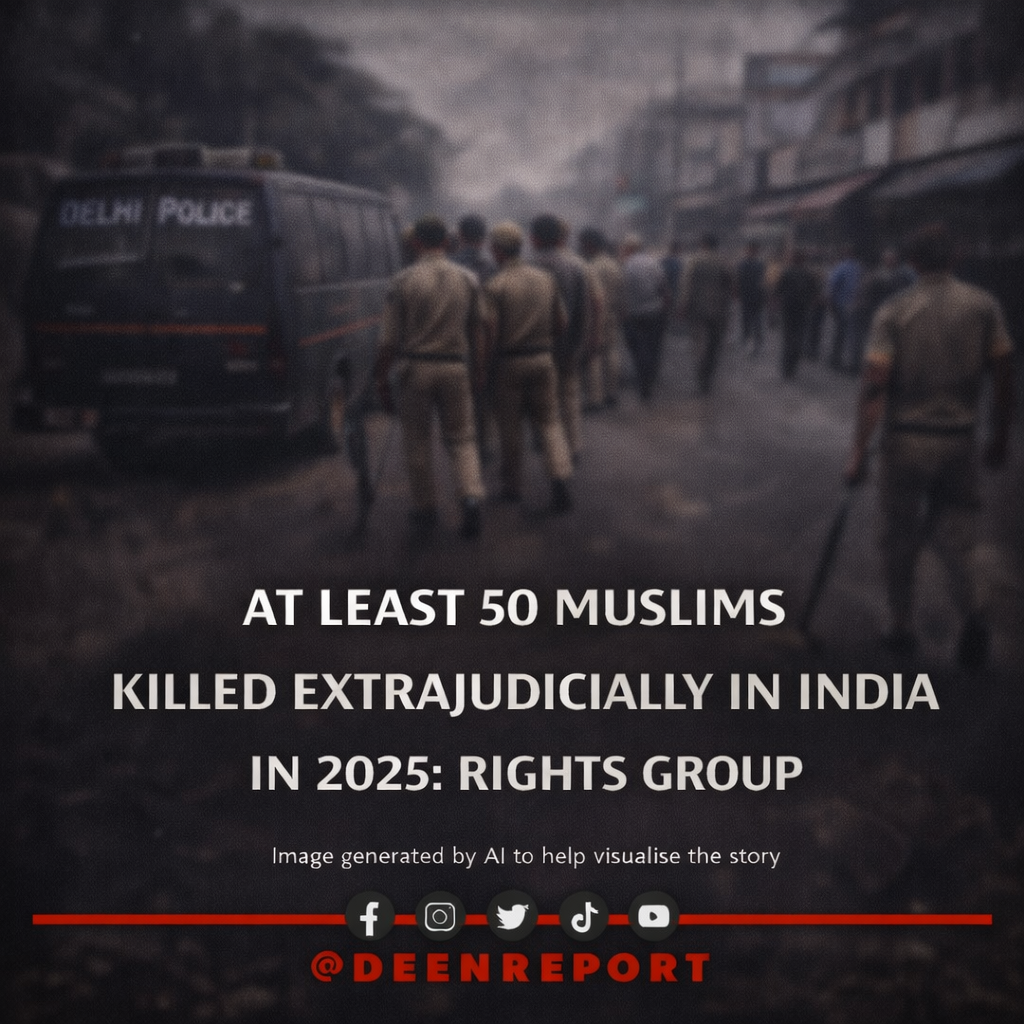
NEW DELHI — A recently circulated report compiled by civil society researchers alleges that at least 50 Muslim civilians were killed extrajudicially in India in 2025, with deaths attributed both to state security forces and to extremist Hindu vigilantes. The findings underscore persistent concerns among human rights groups about disproportionate violence against religious minorities in parts of the country.
The South Asia Justice Campaign’s India Persecution Tracker and related documentation found that within the 50 fatalities reportedly recorded last year, 23 deaths involved security personnel, including police and paramilitary agencies, while 27 were linked to extremist violence carried out by vigilante groups motivated by religious or communal hostility.
Incidents attributed to state actors included “encounter” killings and custodial deaths, and in some cases families alleged denial of medical care following detention or the use of lethal force during raids on Muslim neighbourhoods. Among the fatalities cited in reports were children and young adults, including a 14-year-old boy and a very young infant, highlighting the grave consequences of excessive force.
Human rights experts describe “encounter killings” as extrajudicial shootings in which police claim suspects were killed during armed resistance — a practice frequently criticised for bypassing due process and undermining the rule of law. Independent investigations and human rights bodies have documented patterns of such killings in several Indian states, including Uttar Pradesh and others governed by the ruling Bharatiya Janata Party (BJP).
India’s legal system prohibits arbitrary deprivation of life, and the Constitution guarantees equality before the law. However, international human rights groups and scholars have for years highlighted systemic challenges, including the use of excessive force, custodial deaths, torture and extrajudicial killings — particularly in areas such as Jammu and Kashmir, Uttar Pradesh, Rajasthan and West Bengal — where security operations and communal tensions are recurrent.
A 2025 Human Rights Watch World Report noted persisting allegations of extrajudicial killings alongside other abuses affecting religious minorities, including unlawful demolitions of Muslim homes and properties, and a broader climate of impunity for security forces in violence-prone regions.
Critics of the Indian government’s approach argue that institutional discrimination against Muslims has intensified over recent years, reflected not only in violence but also in exclusionary legislation, social marginalisation, and bias within law enforcement. Analysts say that even when abuses are documented, accountability mechanisms — including judicial remedies and internal police oversight — are often slow, inconsistent or ineffective.
Government officials and security agencies in New Delhi routinely reject claims of systematic targeting and insist that all operations are conducted under the rule of law, with lethal force used only where warranted by threats to life or public safety. Indian authorities also point to the country’s robust democratic institutions, judiciary, and media as safeguards against abuse.
Civil society advocates, including human rights groups and minority organisations, have called for thorough independent investigation of all alleged extrajudicial killings and associated abuses in 2025, stressing that transparent inquiry, oversight and remedies are essential for protecting minority rights in a pluralistic society. They urge the Indian state to honour both constitutional guarantees and international human-rights obligations, including fair trial standards and the prevention of arbitrary killings.
Tracking extrajudicial violence with precision is difficult in India’s complex legal and social environment, and figures vary by source. Researchers caution that the 50-death figure reflects limited reporting and documented cases, and that actual numbers could differ due to under-reporting or classification discrepancies. Despite this, the allegations have sparked renewed debate about law enforcement practices, accountability, and communal harmony in the world’s largest democracy.



Leave a Reply