
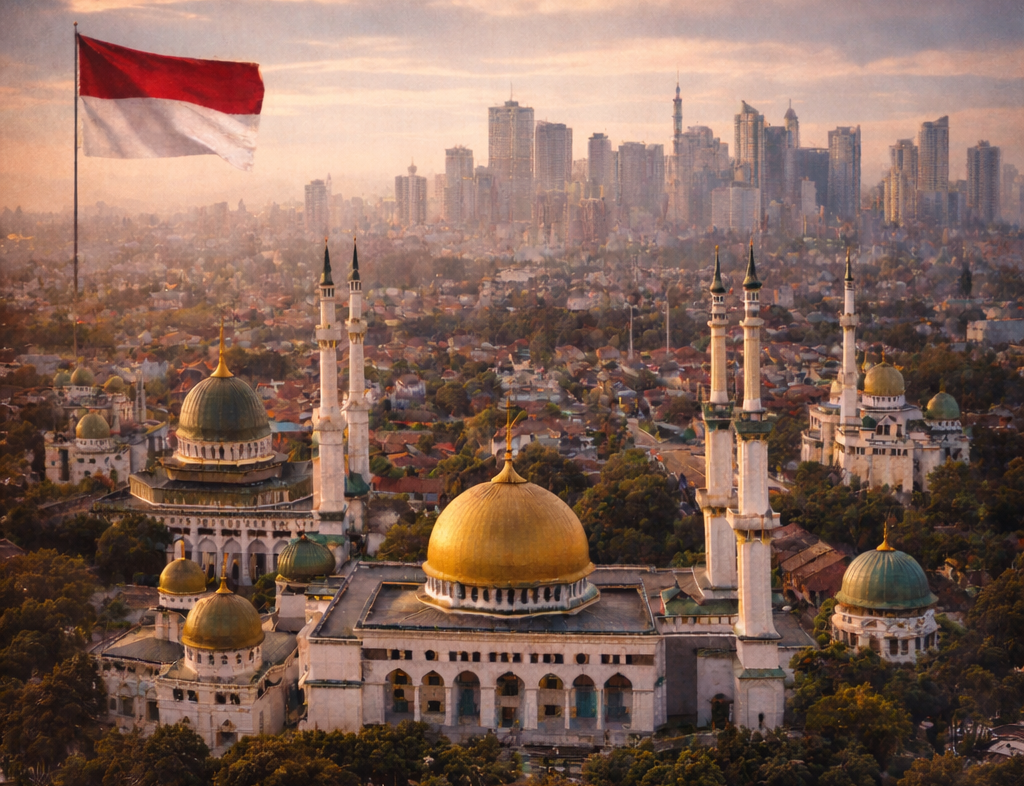
INDONESIA — Indonesia — the world’s most populous Muslim-majority nation — leads globally in the number of mosques, with an estimated around 800,000 places of worship serving Muslim communities across the archipelago, according to commentary cited in social media posts linked to a recent report. The figure reflects Indonesia’s long-standing Islamic heritage and the central role mosque life plays in community, education and daily worship.
The Instagram post, widely shared by users discussing global Muslim demographics, referenced data suggesting that Indonesia’s mosque count surpasses that of any other country. While there is no single unified global registry of mosques, multiple sources and local reports indicate that Indonesia’s extensive network of prayer spaces — from urban centres to rural villages — supports the religious needs of tens of millions of Muslims.
Mosques as Social and Spiritual Anchors
In Indonesia, mosques serve as more than places of prayer: they are community hubs, educational centres, and often the heart of local neighbourhood life. Beyond salat (ritual prayer), many mosques host Qur’anic classes, charity drives, and community discussions, reinforcing social bonds and facilitating civic engagement. Religious leaders in Indonesia often stress that mosque culture — rooted in centuries of Islamic scholarship — nurtures both spiritual growth and communal responsibility.
Despite its size, Indonesia’s mosque count exists within a broader context: Muslim-majority countries across Southeast Asia, the Middle East and Africa also have extensive networks of prayer spaces, each shaped by local history, culture and demographics.
Indonesia’s Islamic Landscape in Broader Perspective
Islam arrived in the Indonesian archipelago through trade and cultural exchange beginning in the 13th century, eventually becoming the dominant faith across diverse ethnic and linguistic groups. Today, Indonesia’s estimated 230 million Muslims — comprising roughly 87–90% of its population — contribute to the country’s recognition as a centre of Islamic life, scholarship and pluralistic religious practice.
The presence of an estimated 800,000 mosques reflects both the decentralised nature of Indonesia’s mosque-building tradition and the importance placed on accessible spaces for worship — not only in major cities like Jakarta and Surabaya but also in remote islands and rural districts.
Islamic Ethical Reflection on Community and Worship
Islamic tradition emphasises both the sanctity of communal worship and the role of the mosque as a space for learning, mutual support and moral guidance. In The Quran, believers are encouraged to maintain prayer and community bonds as part of a cohesive society that upholds dignity and mutual respect.
Teachings in Hadith Books highlight the Prophet Muhammad’s ﷺ emphasis on communal solidarity, shared responsibility and the spiritual value of gathering for prayer and reflection.
Historical narratives from The Seerah illustrate how early Muslim communities established spaces for worship that also served as centres of education, social welfare and dispute resolution — a multifaceted role that continues in many Muslim societies today.
For many Muslims in Indonesia and beyond, the prevalence of mosques symbolizes not only national religious identity but also the enduring value of faith-rooted community life.


Leave a Reply