
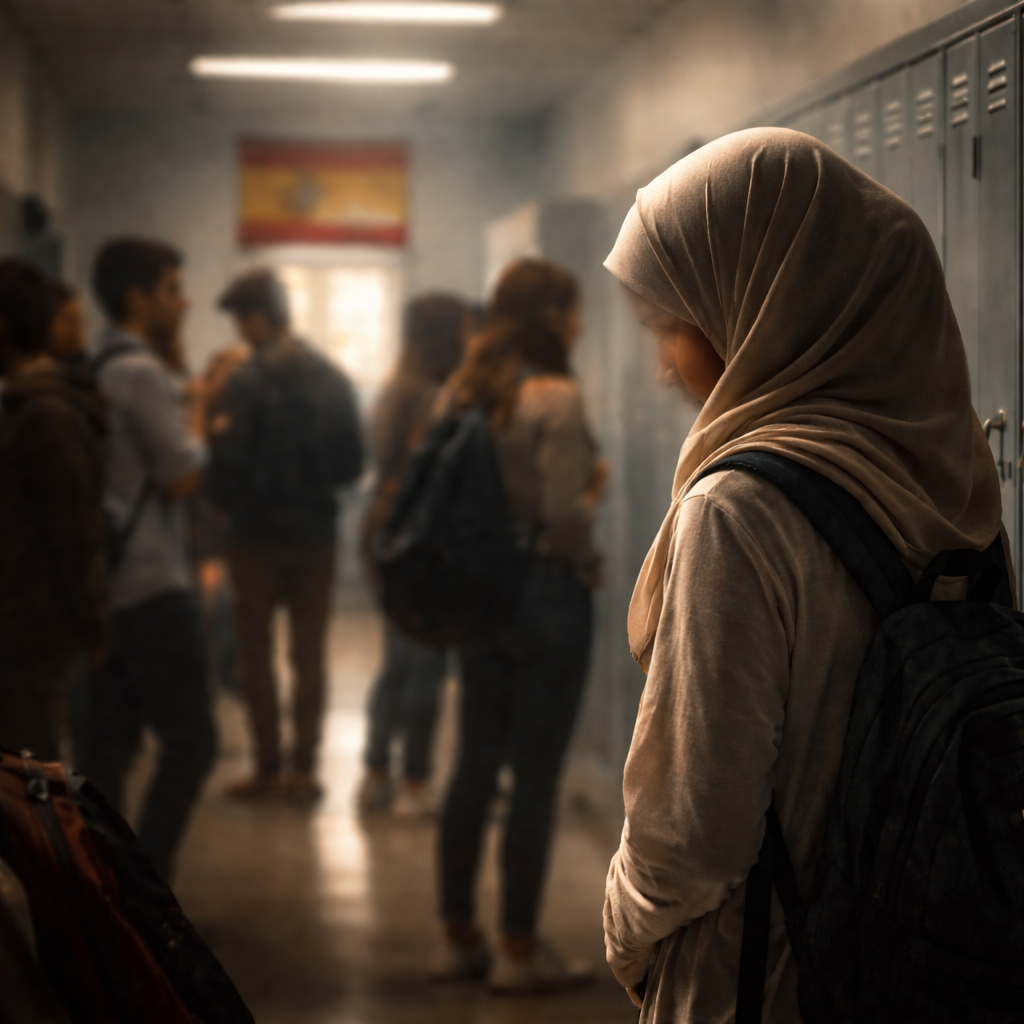
SPAIN — A research report commissioned for Spain’s Institute of Women under the Ministry of Equality says Muslim girls who wear the hijab face recurring discrimination in parts of the education system, including pressure to remove headscarves and the use of school-level internal rules to restrict religious dress. (Source – Instituto de las Mujeres, June 2024)
The report, titled “¡Con eso no! Discriminación de las jóvenes musulmanas con hiyab en el sistema educativo,” states that there is no nationwide legal ban on hijab in Spanish education, but some secondary and vocational training centres have relied on internal regulations that prohibit head coverings to prevent students from attending class unless they remove the hijab. (Source – Instituto de las Mujeres, June 2024)
Researchers linked to the Complutense University of Madrid’s Group for Analysis on Islam in Europe (GRAIS) compiled 73 anonymised cases with support from youth Muslim women’s associations in several regions, then conducted 26 in-depth interviews between April and May 2024, alongside analysis of media coverage and legal disputes. (Source – Instituto de las Mujeres, June 2024)
While the study is qualitative and does not claim to measure prevalence nationwide, it documents patterns ranging from explicit bans to repeated questioning of students’ beliefs and abilities, as well as bullying and dismissive remarks attributed to peers and some staff. (Source – Instituto de las Mujeres, June 2024)
The report’s executive summary describes the use of internal school rules as a form of “minor lawfare,” arguing that policies initially aimed at caps or casual head coverings have been adapted to restrict hijab specifically, sometimes without clearly written rules and instead justified as “the norm.” (Source – Instituto de las Mujeres, June 2024)
Schools’ internal rules and uneven enforcement
Among examples cited in the report is a “case of the headscarf” where a student was expelled during an exam at a Madrid secondary school because the internal rules prohibited wearing a veil, alongside other reported incidents involving students leaving or changing schools after restrictions on head coverings. (Source – Instituto de las Mujeres, June 2024)
The study also describes restrictions during physical education and in training placements, including references to hijab being barred during PE on claimed “health” grounds and reports of headscarf prohibitions during vocational practice placements such as in elder-care settings. (Source – Instituto de las Mujeres, June 2024)
In its legal review, the report highlights three “headscarf cases” that reached the courts in 2010, 2011, and 2021, and argues that rights-based complaints have not reliably reversed restrictive practices, particularly when school internal regulations are treated as controlling. (Source – Instituto de las Mujeres, June 2024)
The authors recommend clearer, binding guidance for schools, changes to internal regulations so hijab is not treated as a generic banned head covering, and stronger systems to detect, record, and respond to Islamophobia in educational settings, including staff training and coordination with relevant public bodies. (Source – Instituto de las Mujeres, June 2024)
The report’s findings sit within broader non-discrimination and rights frameworks in Spain, including Law 15/2022 on equal treatment and non-discrimination, which sets out protections that can apply across education and public life. (Source – Boletín Oficial del Estado, July 2022)
Human rights organisations have previously raised concerns about school-level restrictions on headscarves in Spain, including cases where internal rules were used to exclude students from class, arguing that any limitations on expression or religion must meet human-rights standards and avoid discriminatory impact. (Source – Amnesty International, Feb 2012; Amnesty International, Apr 2013)
Separate European monitoring has noted persistent challenges around racism and xenophobia in Spain, underscoring the need for consistent prevention, reporting, and victim support, factors that advocates say can shape whether students feel safe raising complaints. (Source – ECRI, Oct 2025; OSCE ODIHR, 2024)
Islamic and Ethical Context
For many Muslim families, the hijab is tied to conscience, dignity, and personal religious commitment, and disputes over school access can quickly become disputes over whether a young Muslim woman is treated as fully belonging in public life.
Islamic ethics emphasise justice and the protection of human dignity, including the principle that faith-based practice should not be met with coercion or humiliation; these values are reinforced in The Quran’s broader moral framing on fairness and human worth.
In the Prophetic tradition preserved in Hadith Books, communal life is measured by how harm is reduced and rights are upheld, especially for those who are vulnerable or socially targeted.
The Seerah also records how the Prophet Muhammad (Peace be upon Him) built community cohesion through clear protections and obligations, offering a practical lens for modern institutions—like schools—to set rules that safeguard safety and learning without singling out minority identity for punishment.


Leave a Reply