
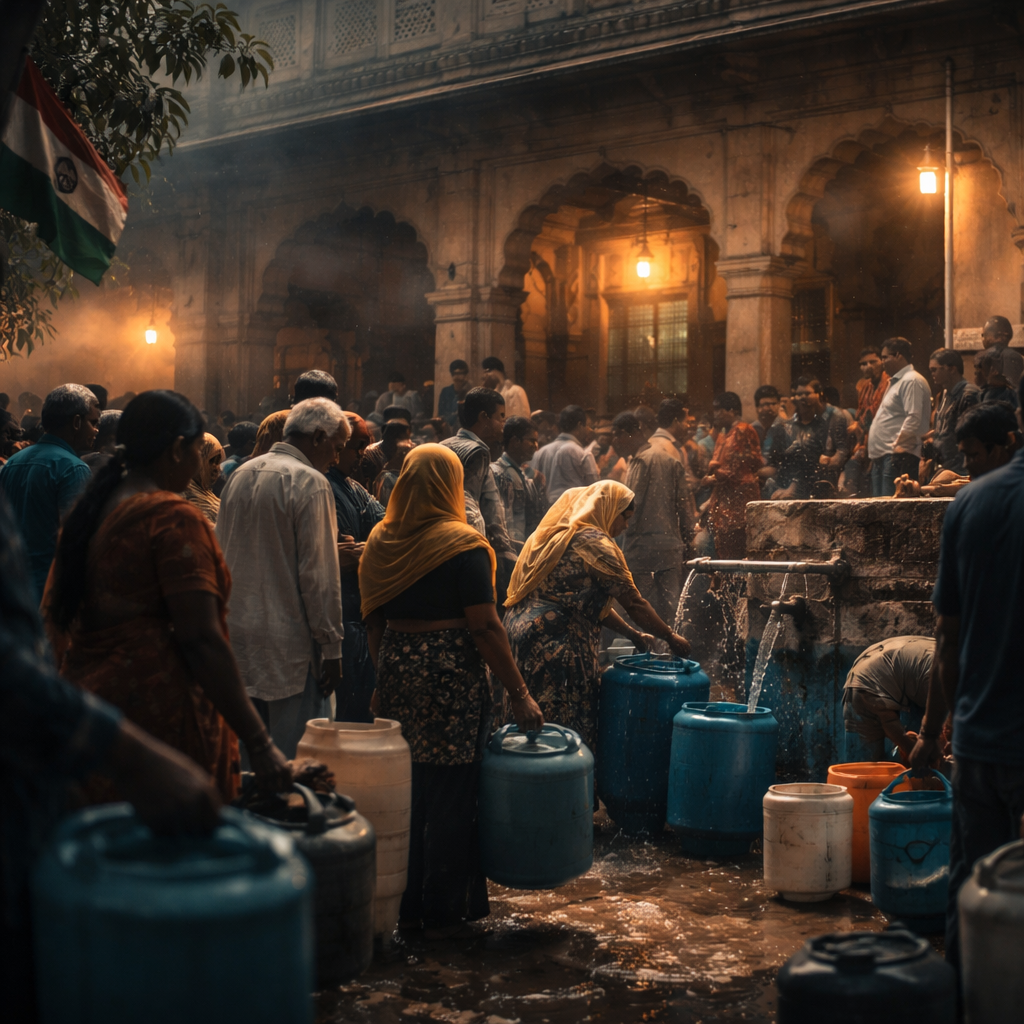
INDIA — A mosque in the western Indian city of Ahmedabad opened its water facilities to local residents of different faiths after a disruption in municipal supply left some households without reliable water, according to multiple local reports and widely shared videos from the area. (Source – Awaz The Voice, Feb. 4, 2026; Siasat, Feb. 3, 2026)
The reports describe Hindu and Muslim families— including women, children and elderly residents—queuing at the mosque premises to fill containers during the shortage. The incident circulated quickly on social media, with several outlets framing it as an example of communal cooperation during a civic emergency. (Source – Awaz The Voice, Feb. 4, 2026; The Observer Post, Feb. 5, 2026)
A mosque official quoted in local coverage said the decision was taken after water supply became erratic in parts of the old city, adding that essential needs should not be tied to identity and that the mosque viewed community service as part of its role. Residents interviewed in the same reports described relief at being able to access water for children and older relatives, saying religious identity “did not matter” in the moment. (Source – Awaz The Voice, Feb. 4, 2026; The Observer Post, Feb. 5, 2026)
Independent reporting did not consistently identify the mosque by name in the coverage reviewed, and the precise neighborhood affected was described broadly as Ahmedabad’s “old city” or “walled city,” making some specifics difficult to verify beyond the shared visuals and quoted accounts. (Source – Awaz The Voice, Feb. 4, 2026; Siasat, Feb. 3, 2026)
Ahmedabad water disruptions highlight deeper infrastructure strain
Ahmedabad’s water supply challenges are not new, with local reporting in recent months pointing to recurring concerns around aging pipelines, contamination risks, and uneven pressure that can worsen shortages in some localities. In January, The Times of India reported that the Ahmedabad Municipal Corporation planned major pipeline work in dozens of “high-risk” areas to reduce contamination risks and strengthen water safety measures. (Source – The Times of India, Jan. 9, 2026)
Separate reporting from the same outlet cited city data showing repeated outbreaks of waterborne illness over recent years and linked ongoing vulnerability to infrastructure flaws such as sewage mixing with drinking water in some areas—an issue civic officials have acknowledged as a structural challenge. (Source – The Times of India, Jan. 4, 2026)
City infrastructure work has also affected supply in parts of Ahmedabad. In mid-January, The Indian Express reported on the demolition of a decades-old overhead water tank in the Sarangpur area after it was declared unsafe, noting that water supply from that tank had been stopped earlier and alternative arrangements were made by the civic body. (Source – The Indian Express, Jan. 16, 2026)
Meanwhile, regional reporting has described efforts to expand and stabilize supply to meet rising demand. DeshGujarat reported that an additional allocation of raw water from the Narmada canal system was approved for Ahmedabad, citing municipal and state-linked agencies as discussing upgrades to treatment capacity and addressing shortages tied to canal maintenance. (Source – DeshGujarat, Jan. 30, 2026)
For many Muslims in India, episodes like the Ahmedabad mosque’s response carry added meaning because communal relations can be fragile and Muslims are frequently scrutinized in public life. Acts of public service offered without distinction can help reduce suspicion at the neighborhood level, even as broader political and social pressures remain. (Source – Awaz The Voice, Feb. 4, 2026)
Islamic and Ethical Context
In Islamic tradition, water is treated as a mercy and a shared necessity, and community welfare is not limited to one’s own group. The Quran repeatedly frames essential provisions as gifts that sustain life and society, encouraging gratitude and responsible stewardship without turning basic rights into tools of exclusion.
Muslim scholars often point to Hadith Books emphasizing the protection of neighbors, removing harm, and responding to need—principles that translate in practical ways during emergencies, including sharing food, shelter, and water. When a mosque functions as a place where neighbors can access necessities with dignity, it reflects the idea that worship and service are connected rather than competing priorities.
The Seerah includes examples of Prophet Muhammad (Peace be upon Him) building community cohesion through fairness, trust-building, and care for the vulnerable, including those outside the Muslim community. In that ethical light, the Ahmedabad incident is best understood not as a publicity moment, but as a reminder of how faith institutions can uphold human dignity when municipal systems fail—while also underscoring the public obligation to ensure safe, reliable water for every household, regardless of religion or status.

Leave a Reply