
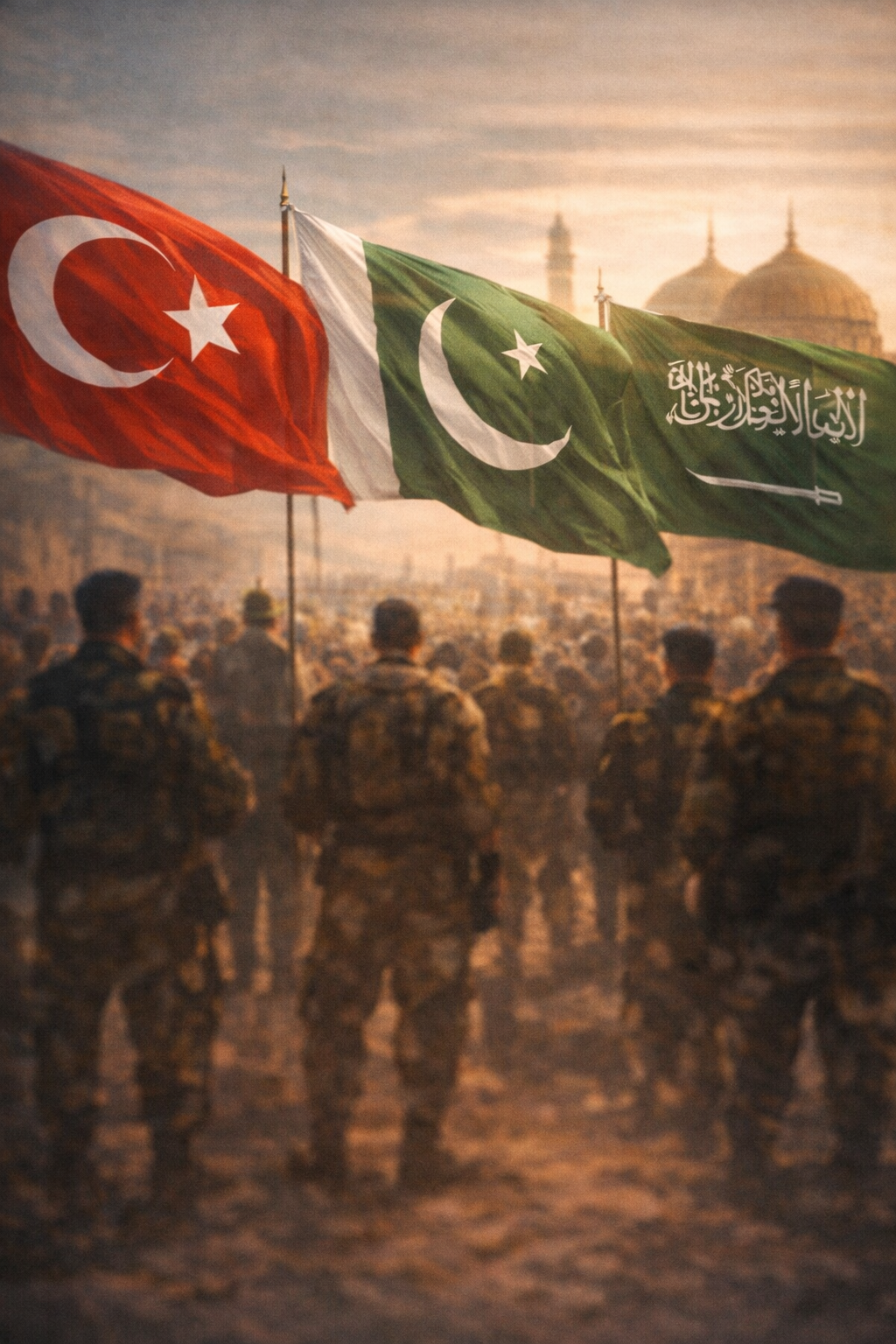
ANKARA / RIYADH / ISLAMABAD — Turkey is reported to be in advanced negotiations to join a defence agreement between Saudi Arabia and Pakistan that would commit members to a collective defence clause — treating an attack on one as an attack on all — similar to NATO’s Article 5. This potential trilateral framework, described by analysts as a possible “Islamic NATO,” could reshape security dynamics across the Middle East, South Asia and beyond.
The original pact between Saudi Arabia and Pakistan — formally known as the Strategic Mutual Defence Agreement (SMDA) — was signed in September 2025 in Riyadh. Under the treaty, both countries pledged that aggression against one would be treated as aggression against both, a collective security principle reminiscent of NATO.
Talks with Turkey — a long-standing member of NATO with the alliance’s second-largest military — are said to be at an advanced stage. If concluded, Ankara’s participation would expand the Saudi-Pakistan arrangement into a formal, multi-state defence cooperation mechanism that draws on Turkey’s conventional military capabilities, Pakistan’s strategic deterrent and Saudi Arabia’s financial resources.
Strategic Rationale and Regional Context
For Turkey, the move represents part of a broader diversification of security partnerships beyond Western alliances. Ankara’s growing defence cooperation with Islamabad — including drone technology, naval platforms and joint training — has deepened in recent years, signalling a convergence of interests. Similarly, Riyadh and Islamabad see mutual defence alignment as a hedge against regional instability and uncertain security commitments from traditional Western partners.
Analysts suggest the trilateral pact is emerging amid shifting geopolitical currents, including questions about U.S. strategic focus in the region and persistent conflicts involving Yemen, Gaza and Afghanistan. Supporters argue a collective defence framework could enhance deterrence and crisis response capabilities for member states. Critics caution that defining such ties primarily through a religious lens oversimplifies the complex strategic calculus driving these agreements.
Implications for Security Dynamics
If realised, a Turkey–Saudi Arabia–Pakistan defence arrangement could affect broader regional alignments, prompting neighbouring states — including India, Iran and other Gulf Cooperation Council members — to reassess their security postures. For Muslim communities globally, the development highlights increasing strategic collaboration among major Muslim-majority states, even as it raises questions about the role of collective defence frameworks in areas of longstanding tension.
Observers emphasise that while the “Islamic NATO” label captures public imagination, the proposed pact remains distinct from the institutionalised structures, decision-making processes and integrated command systems that characterise the North Atlantic Treaty Organization. Instead, it exemplifies pragmatic security cooperation amid evolving global power distributions.



Leave a Reply