
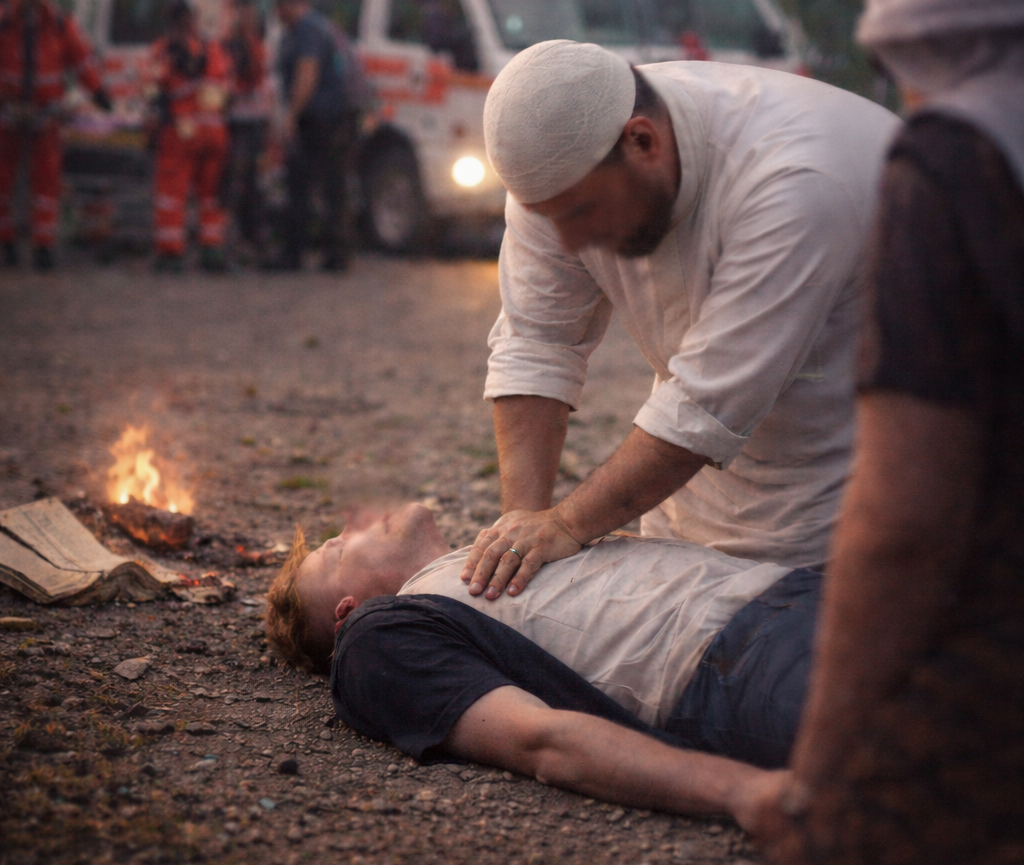
UNITED STATES — A Muslim man intervened to save the life of an individual widely known online for burning the Quran, in an incident that has drawn significant attention across social media and reignited debate over faith, forgiveness, and moral conduct amid hostility.
The individual saved has been identified in online posts as Jake Lang, a far-right activist previously associated with inflammatory anti-Muslim actions, including publicly burning a copy of the Quran. According to multiple video clips and eyewitness accounts circulating online, Lang was in medical distress when the Muslim man stepped in to provide urgent assistance, preventing what appeared to be a potentially fatal outcome.
While full official details have not yet been released by emergency services, footage shows the Muslim rescuer prioritising saving a life despite the victim’s history of provocation and religious insult, a moment that many observers described as striking and unexpected.
A Moment That Cut Through Polarisation
The incident has resonated widely because of the stark contrast between past acts of provocation and the response shown in the moment of crisis. For many Muslims, Quran burnings are experienced not merely as political acts but as deeply offensive attacks on sacred belief and communal dignity. Yet the decision to intervene reflected a different moral calculus — one rooted in the sanctity of life.
Muslim community figures commenting online emphasised that Islam does not permit withholding aid or compassion, even toward those who have caused harm or offense. Several noted that the act demonstrated restraint and ethical clarity in a climate often defined by escalation and retaliation.
At the same time, rights advocates stressed that the lifesaving intervention does not excuse or legitimise past acts of hate, nor does it diminish the harm caused by religious desecration. Rather, they said, it underscores a moral distinction between accountability for speech or actions and the obligation to preserve life.
Public Reaction and Broader Implications
Reactions online have ranged from praise to disbelief. Many users described the incident as a powerful counter-narrative to stereotypes about Muslims and Islam, while others said it highlighted how dehumanisation breaks down when confronted with real human vulnerability.
Some commentators contrasted the episode with previous incidents in which Quran burnings were defended under “free speech,” noting that the Muslim response was not symbolic or performative but practical and lifesaving.
Analysts say moments like this often cut through ideological framing because they present a clear ethical choice: save a life or let grievance decide action.
Islamic Ethical Context
Islamic teachings place the preservation of human life at the highest moral level. In The Quran, saving a single life is described as akin to saving all of humanity, a principle frequently cited in discussions of medical ethics and humanitarian conduct.
Teachings recorded in Hadith Books emphasise mercy, restraint, and assisting others in distress regardless of personal grievance. The Prophet Muhammad ﷺ repeatedly instructed his followers to act with compassion even when wronged.
Historical examples from The Seerah show that the Prophet ﷺ often responded to hostility not with vengeance, but with moral clarity and concern for life — even in cases where he himself had been targeted or insulted.
For many Muslims, the incident has come to symbolise the difference between provocation and principle, and between reaction and responsibility.
What Comes Next
As the video continues to circulate, community leaders have urged caution against turning the episode into political spectacle. They stress that the focus should remain on the value of human life, not on rehabilitating or amplifying individuals known for hateful conduct.
Authorities have not announced any formal investigation related to the incident itself, and it remains unclear whether further official statements will follow.
What is clear, however, is that the moment has forced a public reckoning with a simple but profound question: What does moral integrity look like when it is hardest to uphold?

Leave a Reply