
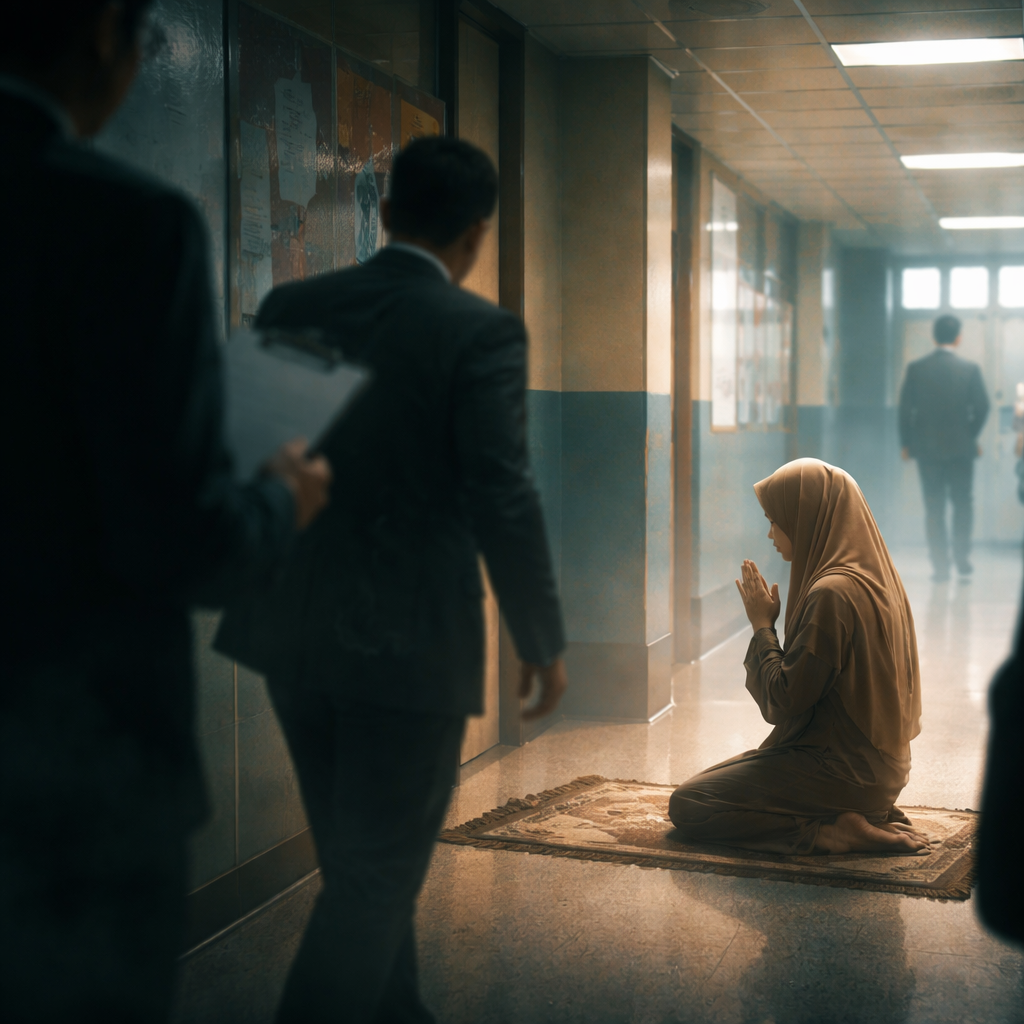
NETHERLANDS — The Netherlands Institute for Human Rights has ruled that a public secondary school in Hoofddorp discriminated against a Muslim student by interrupting her while she prayed at school and by rejecting a request to create an inclusive quiet room that could be used for worship or reflection. (Source – College voor de Rechten van de Mens, January 29, 2026; NL Times, January 29, 2026)
The case concerns the Haarlemmermeer Lyceum TTO, which falls under Stichting Dunamare Onderwijsgroep. The Institute’s decision, numbered 2026-20, described how the student began seeking calm places on campus to pray during free time because no designated quiet space existed. (Source – College voor de Rechten van de Mens, January 29, 2026)
According to the ruling, a deputy principal intervened in April 2024 while the student was praying in an open study area, with the school arguing she was obstructing passage and that intervention was needed for accessibility and safety. The Institute said the school did not convincingly substantiate that the student was blocking others at that moment or that immediate intervention was unavoidable, and concluded the school failed to rebut a presumption of direct discrimination on religious grounds. (Source – College voor de Rechten van de Mens, January 29, 2026)
The dispute also centered on a request for an “inclusive” quiet room. The Institute noted that a fellow student started a petition for a quiet space accessible to all students, regardless of religion, which received 235 signatures. The school ultimately decided not to create such a room, reasoning that it would likely be used mainly by Muslim students and could be seen as granting them a privileged position. (Source – College voor de Rechten van de Mens, January 29, 2026; NOS, January 29, 2026; RTL Nieuws, January 29, 2026)
The Institute rejected that logic, stating that expressing a religious belief is a fundamental right and not a “privilege,” and found direct discrimination where the school explicitly pointed to the Islamic faith of Muslim pupils as a reason not to establish the space. The decision is non-binding, but it carries persuasive weight and is often used to guide policy and dispute resolution. (Source – College voor de Rechten van de Mens, January 29, 2026; NL Times, January 29, 2026)
School leadership has publicly disagreed with the ruling, saying the institution is secular and aims to serve all students without creating religious facilities for specific groups, while maintaining that students may pray as long as it does not disrupt classes or cause hindrance. (Source – NL Times, January 29, 2026; NOS, January 29, 2026)
Wider debate on prayer and neutrality in Dutch schools
The Hoofddorp case lands amid broader national debate about how public schools accommodate religious practice. In 2025, reports and student accounts circulated in Dutch media alleging that some secondary schools restricted or discouraged prayer during breaks, with Muslim students often most affected because daily prayers occur at set times. (Source – NL Times, February 25, 2025)
Education-sector organizations have urged schools to keep dialogue open and develop workable, school-specific policies, noting that students may seek low-stimulus or quiet spaces for multiple reasons, including prayer, while also emphasizing schools’ discretion in whether to formally facilitate such rooms. (Source – VO-raad, May 27, 2025)
Government responses in recent years have also highlighted school-level discretion on whether to establish prayer or quiet rooms, a stance that has sometimes clashed with discrimination rulings in individual cases when a refusal is tied to religious identity or results in unequal treatment in practice. (Source – RTL Nieuws, June 15, 2023; College voor de Rechten van de Mens, January 29, 2026)
For many Muslim families, the Hoofddorp ruling is likely to be read less as a demand for special treatment and more as a test of whether equal participation in public education includes reasonable space for basic religious practice—especially when students try to pray quietly during non-instructional time. (Source – College voor de Rechten van de Mens, January 29, 2026; NOS, January 29, 2026)
Islamic and Ethical Context
Islam places strong emphasis on justice, dignity, and fulfilling obligations without harming others. In this kind of dispute, Muslim students often frame their needs around praying discreetly, respecting school routines, and seeking solutions that avoid disruption—principles consistent with public order and mutual consideration highlighted throughout The Quran.
Islamic teachings also stress fairness in how people are treated in shared institutions. Hadith Books include guidance on removing harm and maintaining good conduct in public life, which can be understood as encouraging Muslims to practice their faith with care for those around them while also expecting equitable treatment when they do so.
In The Seerah, the Prophet Muhammad (Peace be upon Him) is described engaging communities with practical wisdom and seeking workable arrangements that protect rights without inflaming division. That ethic points toward transparent school policies, respectful dialogue, and solutions—like genuinely inclusive quiet spaces—where feasible, so that belonging does not come at the cost of conscience.



Leave a Reply