
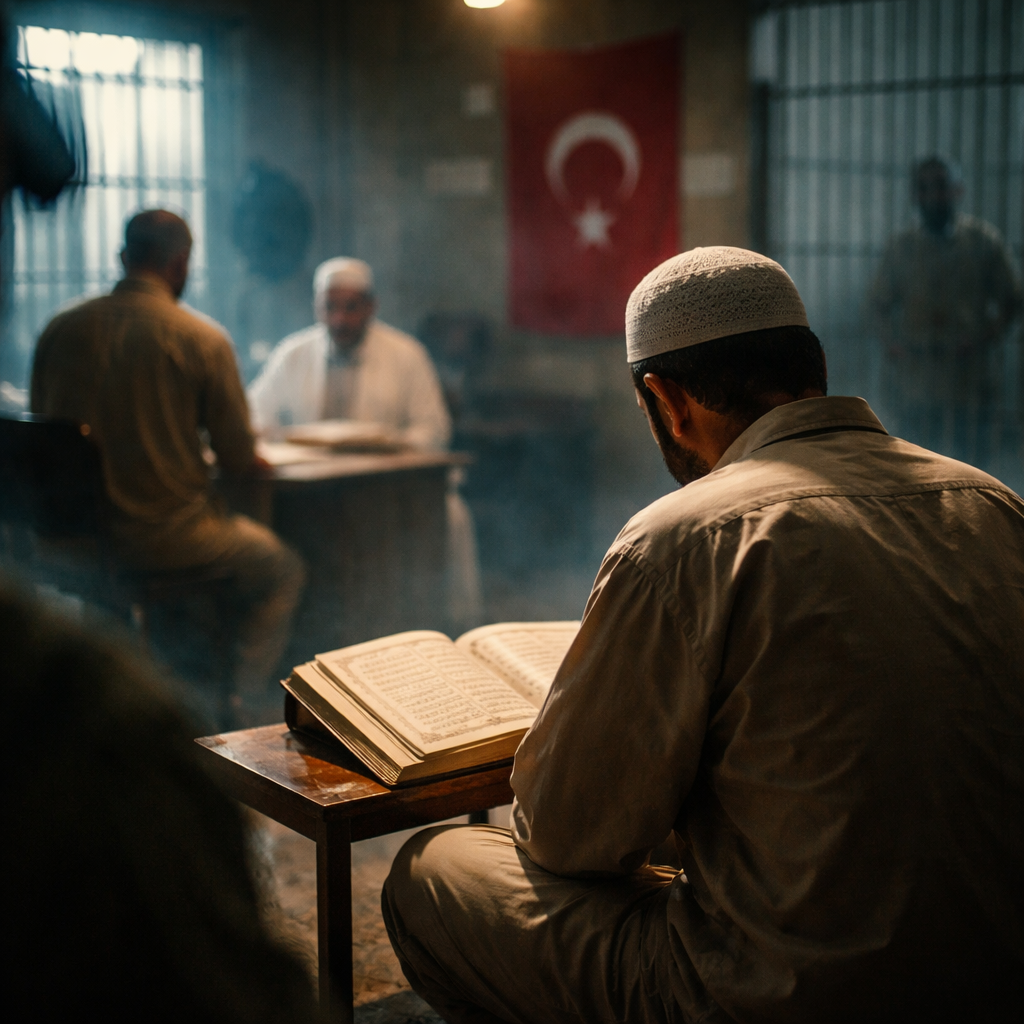
TURKEY — A detainee at Balıkesir’s Kepsut Closed Penal Institution has completed a full Quran memorization track and received a formal certification after passing an official assessment, Turkish religious authorities and local reporting said this week. (Source – Daily Sabah, Jan. 29, 2026; Balıkesir Müftülüğü, Jan. 29, 2026)
Officials said the achievement came through a prison-based “spiritual guidance” unit operating under a cooperation protocol between Turkey’s Justice Ministry and the Presidency of Religious Affairs (Diyanet), a state institution that oversees religious services. (Source – Daily Sabah, Jan. 29, 2026)
According to the Balıkesir Mufti’s Office, the detainee completed the memorization curriculum and then sat a “hafızlık verification exam” overseen by a commission appointed by Diyanet, clearing the requirements for a hafız certification. (Source – Balıkesir Müftülüğü, Jan. 29, 2026; Diyanet Haber, Jan. 27, 2026)
The case is being presented by officials as part of a broader rehabilitation approach that frames education — including religious education for those who choose it — as a pathway to discipline, self-improvement, and reintegration after incarceration. (Source – Daily Sabah, Jan. 29, 2026)
Rehabilitation programs and prisoners’ rights questions
Turkey, like many countries, has expanded education and structured activities in custodial settings in recent years, with policy debates often focusing on whether programs are effective at reducing reoffending and supporting reintegration into family and working life. (Source – Justice Trends, Mar. 3, 2025; Learning for Development Journal, 2023)
Research on prison education commonly emphasizes that participation, quality, and continuity after release are key factors in whether learning programs translate into long-term outcomes, rather than being short-term achievements without support. (Source – Learning for Development Journal, 2023)
International human-rights standards also stress that access to education should be available to all prisoners and that detention does not remove a person’s inherent dignity or basic rights beyond restrictions necessary for incarceration. (Source – OHCHR, Dec. 14, 1990)
On religion specifically, detention monitors and rights guidance documents underline that prisoners must be protected from coercion or discrimination, including the right to practice a faith — and the right not to practice any religion — without pressure from authorities or other detainees. (Source – Association for the Prevention of Torture, Jan. 31, 2026)
In Turkey, these principles have been raised in public discussion in past years after occasional media reports and prisoner accounts alleged pressure to attend religious activities in certain facilities — claims that remain contested and vary by institution, but which reinforce calls for clear safeguards and voluntary participation. (Source – Duvar English, Nov. 3, 2021)
Islamic and Ethical Context
For many Muslims, memorizing The Quran is not only a personal spiritual milestone but also a disciplined commitment that can cultivate patience, accountability, and steadiness — qualities that can matter for someone trying to rebuild life after wrongdoing or hardship.
Within Hadith Books, the Prophet Muhammad (Peace be upon Him) is described as encouraging repentance, mercy, and practical reform, and Muslim scholars have long highlighted that spiritual growth is meant to show in character and conduct, not only in words.
In The Seerah, early Muslim community life includes examples of people who made serious mistakes but were not permanently defined by them, with emphasis placed on justice, responsibility, and pathways back to moral and social good.
At the same time, Islamic ethics aligns with widely cited human-rights principles that emphasize dignity and non-coercion in custody, reinforcing that any faith-based support should be offered as a genuine choice and alongside broader learning and rehabilitation services for all prisoners.



Leave a Reply