
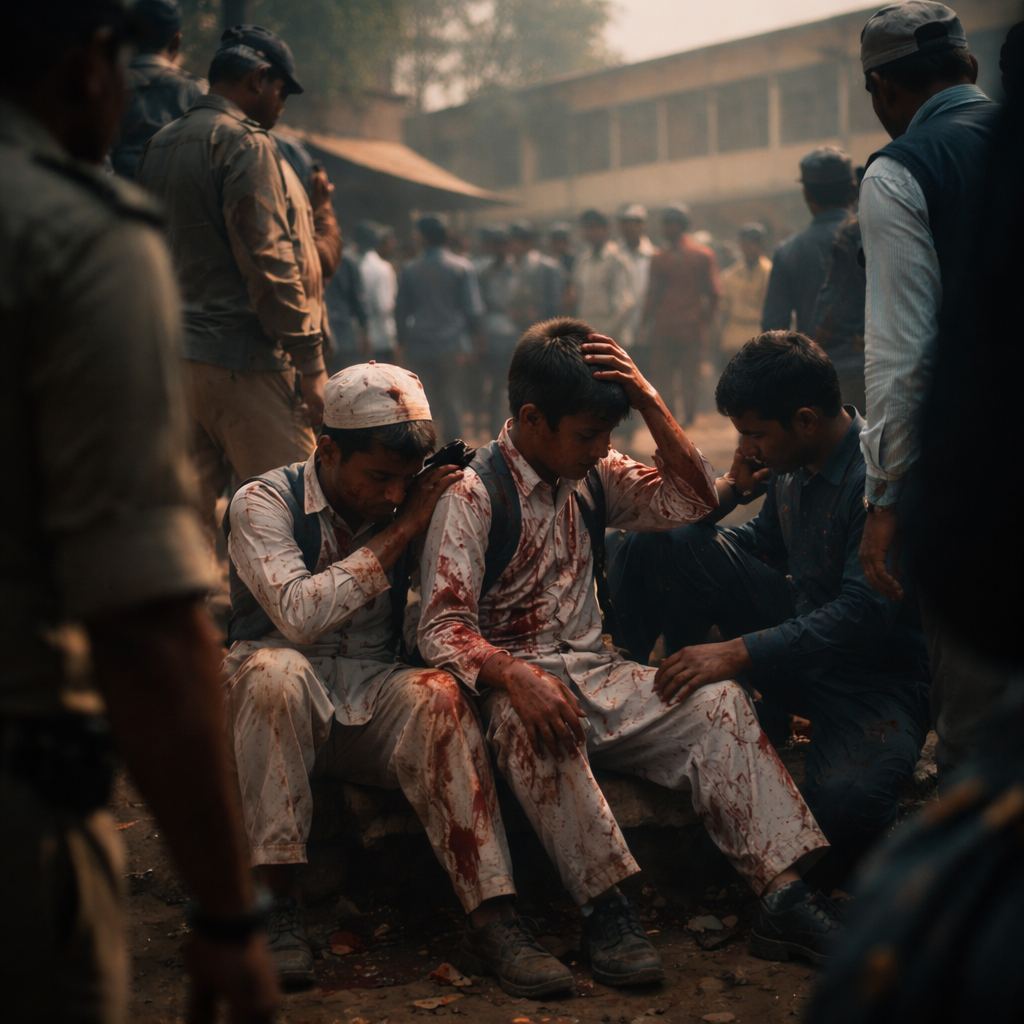
INDIA — Three Muslim minors in India’s eastern state of Jharkhand were assaulted on school grounds in Lohardaga district, according to local reports and interviews given by one of the injured boys, who said the attack was linked to their religious identity. The accounts describe classmates acting with several outsiders, with the boys sustaining visible injuries and the school facing questions over security and supervision. (Source – The Siasat Daily, February 4, 2026; Radiance News, February 5, 2026; Public App, January 28, 2026)
The incident was reported at PM Shri Utkrimit Uchcha Vidyalaya Kujra in Kujra village, within the Lohardaga Sadar police station area, with local reporting placing the violence at around 1 p.m. on January 28. A Hindi-language local report said three minors were injured, including one student in Class 7 and two in Class 10, with two suffering head wounds and another reporting a serious injury. (Source – Public App/IHQ News, January 28, 2026)
In accounts carried by regional outlets, one injured student, identified as Abrar Ansari, said the group involved roughly 20 to 25 people and included both students and outsiders. He alleged that the abuse escalated after hostile slogans were raised against Muslims and that the boys were dragged back into a classroom before being attacked. (Source – Radiance News, February 5, 2026; The Siasat Daily, February 4, 2026)
Local reporting also highlighted allegations of institutional failure at the school, with the injured boys saying teachers present did not intervene during the assault. Separately, interviews and clips circulating online showed the boys speaking to reporters while still in bloodstained uniforms, though such footage does not independently confirm the full sequence of events or the motive alleged by the victims. (Source – Radiance News, February 5, 2026; The Siasat Daily, February 4, 2026)
Authorities had not publicly released detailed findings on arrests, disciplinary steps, or case details as of early February, according to outlets that first reported the incident. The absence of an official public account has left key points — including how outsiders entered during class hours and whether staff followed any emergency protocol — unresolved. (Source – Radiance News, February 5, 2026; Public App/IHQ News, January 28, 2026)
School safety and accountability questions
Violence in schools is a broader challenge in India and across South Asia, where child-safety experts have urged stronger prevention, reporting pathways, and safeguarding responses that do not depend on a child’s identity. A recent country report on preventing violence against children in schools in India emphasized clearer safeguarding policies, staff training, and accountability mechanisms when incidents occur on campus. (Source – Coalition for Good Schools, September 2025)
The Jharkhand case has also revived a recurring concern raised by parents in similar incidents: when violence involves “outsiders,” schools may be facing lapses in access control, supervision at gates, and rapid response procedures once a conflict begins. Global child-welfare guidance commonly stresses that timely intervention, documentation, and support for affected children are critical after violent incidents, including cases linked to bullying and discrimination. (Source – UNICEF, accessed February 2026; Coalition for Good Schools, September 2025)
For many Muslims in India, reports of discriminatory rhetoric and harassment in public life have contributed to a sense that everyday spaces — including classrooms — can be affected by wider social tensions. Human Rights Watch has repeatedly cited concerns about discrimination and violence affecting religious minorities, while the U.S. Commission on International Religious Freedom has documented hate speech and harassment targeting minorities, including Muslims, in recent reporting years. (Source – Human Rights Watch, February 4, 2026; USCIRF, April 2025)
Data and monitoring efforts also point to the role of hostile rhetoric in shaping community fears. A report by Reuters on the India Hate Lab’s findings said anti-minority hate speech events rose sharply in 2024, with Muslims the most frequently targeted group in the database, while Indian authorities have rejected allegations that government policy encourages division. (Source – Reuters, February 10, 2025)
Islamic and Ethical Context
In Islamic teachings, the safety and dignity of children is a communal responsibility, and harm committed against any child is treated as a serious moral wrong. The Quran repeatedly frames human dignity and the protection of the vulnerable as core principles that should guide public conduct, including in institutions entrusted with education.
Hadith Books include well-known teachings of the Prophet Muhammad (Peace be upon Him) that emphasize mercy, justice, and the prohibition of harming others, especially those under one’s care. In a school setting, these principles translate into a clear expectation that adults intervene to stop wrongdoing and that communities work to prevent humiliation and violence directed at any child.
The Seerah records how the Prophet Muhammad (Peace be upon Him) responded to hostility without normalizing cruelty, while building agreements and social norms that protected weaker members of society. Applied to the present case, Muslim community leaders and school authorities can draw on these ethical lessons by prioritizing truthful fact-finding, rejecting collective blame, and insisting on safeguards that ensure every student can learn without fear.



Leave a Reply