
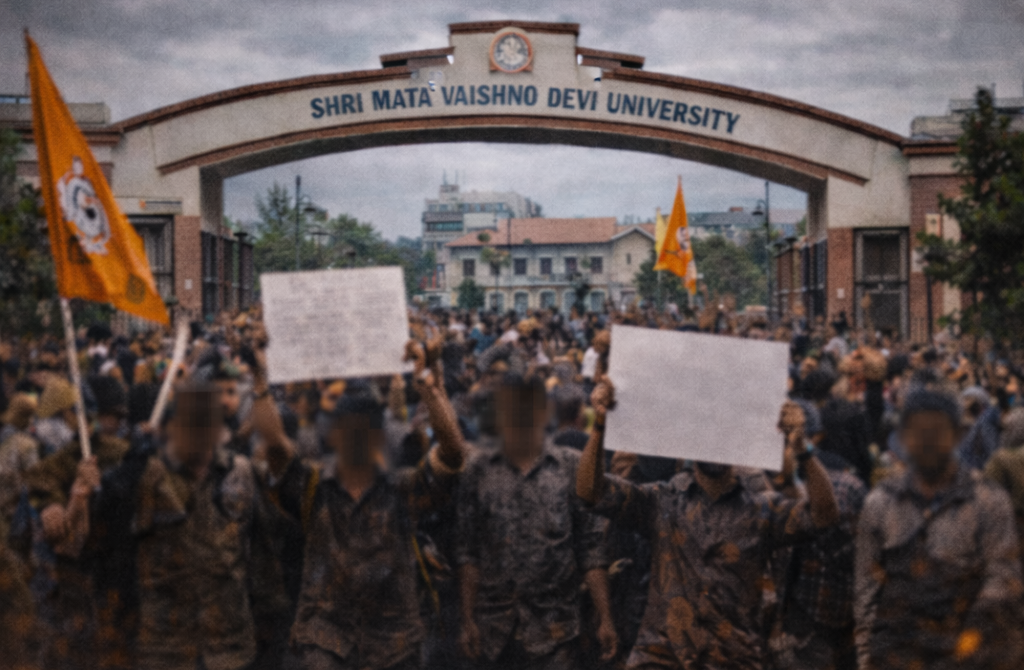
Indian authorities have revoked the recognition of a newly opened medical college in the Reasi district of Indian-administered Jammu & Kashmir, following weeks of protests by right-wing Hindu groups objecting to the high number of Muslim students admitted to its inaugural MBBS class. This decision has sparked intense debate over merit, community tensions, and minority rights in India’s complex socio-political landscape.
The National Medical Commission (NMC), the federal regulatory body for medical education in India, announced on January 6, 2026, that it had revoked recognition of the Shri Mata Vaishno Devi Institute of Medical Excellence (SMVDIME) in Reasi, effectively shutting down its MBBS programme and transferring enrolled students to other recognised institutions.
Protests and Political Pressure
The move came after persistent demonstrations by local right-wing Hindu groups, who argued that the college — financed in part by donations to the Mata Vaishno Devi temple trust — should prioritise Hindu students. Many protesters objected to the fact that out of 50 students admitted for the 2025-26 academic year, 42 were Muslim, with the majority securing places on merit through India’s national medical entrance exam (NEET).
Supporters of the protests framed their demands as a call for cultural and religious representation within a temple-linked institution. However, critics — including legal experts and civil rights advocates — pointed out that admissions were conducted according to standard national guidelines based on merit and domicile status, and that attempts to engineer admissions by religion contradicted constitutional protections against discrimination.
Authority’s Justification and Opposition
The NMC’s official statement cited infrastructure and compliance concerns, including deficiencies in library resources, faculty numbers and associated hospital facilities, as grounds for revoking recognition. It also said that affected students would be redeployed to other medical colleges to ensure continuity of their education.
Prominent politicians from the ruling Bharatiya Janata Party (BJP) welcomed the decision, with some characterising it as an assertion of educational standards. Opponents, including former Jammu & Kashmir political leaders, warned that the closure sets a dangerous precedent, signalling that political pressure and communal arguments can override merit-based admissions and regulatory processes.
Wider Implications and Community Impact
For Muslim families and students across Jammu & Kashmir and India, the controversy has reverberated beyond Reasi. Critics contend that the episode feeds into broader anxieties about communal bias in access to opportunities, particularly in regions with deep historical and political fault lines. Some commentators fear that the college’s closure may discourage Muslim aspirants from pursuing careers in professions where representation is already thin.
Legal scholars emphasise that India’s constitution prohibits discrimination on the basis of religion in public institutions and insists on equal treatment under the law. They argue that admissions decisions tied strictly to academic merit and eligibility criteria should not be subject to interruption by protests grounded in sectarian objectives.
Observers note that the SMVDIME case is symptomatic of intensifying debates in India over meritocracy, identity politics and the role of religion in civic life — tensions that have manifested across educational institutions, employment realms, and public policy discussions. As the transferred students resume their medical training elsewhere, the controversy underscores lingering challenges in balancing regulatory standards with societal cohesion.
Leave a Reply